
Protect Lowndes County wants economic opportunity. We want businesses that hire local people, opportunities for young people to stay, and investment that strengthens the communities already here.
We also believe development must respect the place where it happens. In Lowndes County, that means respecting homes, protecting shared resources and recognizing the extraordinary civil rights history carried by this landscape.
PLC opposes Project Red Clay at its proposed location because we believe it fails that test. Our opposition is a judgment about this project, this site and Cloverleaf’s approach to the people who would live beside it.
Lowndes County deserves a future that builds on what makes it valuable.
This is land where people risked their lives for a voice
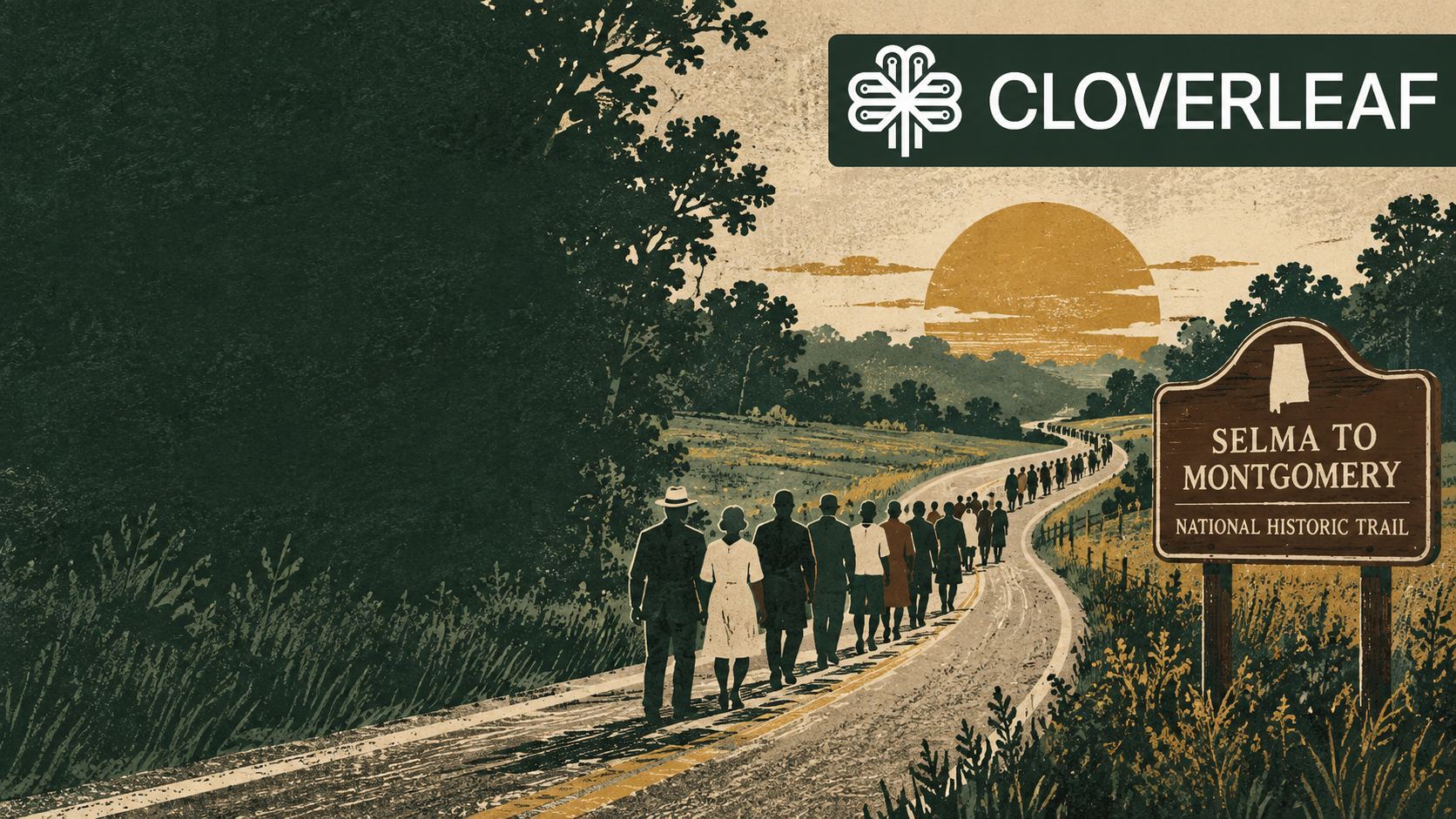
The proposed development lies along U.S. Highway 80, the route of the Selma to Montgomery National Historic Trail. Its setting connects this proposal to one of the most consequential struggles for voting rights in American history.1
The nearby Robert Gardner Farm served as the third campsite of the 1965 march. According to the National Park Service, Robert and Mary Gardner faced attempted bribery, threats of violence and the cutting of their telephone and power lines because they supported the marchers. After the marchers departed, a National Guardsman discovered a neighbor aiming a scoped rifle toward the family farm.23
Elsewhere along the route, Rosie Steele opened her property to marchers as their second campsite. The Park Service records that local vendors subsequently refused to supply her store. Supporting the movement carried consequences for the people who owned land and ran businesses here.4
These were people protecting a movement with what they had: their land, their homes and their willingness to stand beside others.
PLC believes their sacrifices place a responsibility on those making decisions about this landscape today. The physical places that help tell this history deserve careful protection. So do the communities that continue to live around them.
Protecting history means considering its surroundings
Historic preservation cannot stop at leaving a marker beside the road.
The surrounding fields, homes and views help people understand that the march passed through a living rural community. PLC believes a major industrial development in this setting requires scrutiny of how it would change that experience, including its buildings, lighting, sound and associated infrastructure.
This concern predates Project Red Clay. In its 2015 foundation document, the National Park Service identified concerns about incompatible development encroaching on views along Highway 80. That discussion addressed the trail’s landscape, including the area around Tent City. It was not a finding about Project Red Clay, but it demonstrates that the setting itself has long been a preservation concern.5
PLC’s position is that this historically significant corridor deserves a development approach shaped by preservation from the outset. A developer should be able to demonstrate how a proposal respects the landscape before asking the community to accept it.
Access to a highway or transmission line does not answer that question.
The history also asks us to take residents seriously
The civil rights struggle in Lowndes County concerned who could participate in public life and whose voice would count.
The National Park Service’s account of Lowndes Tent City records that Black families were evicted by White landowners in retaliation for attempting to register to vote. Tent City provided shelter for families who faced the loss of their homes for exercising that right.6
That history should inform how we practice public decision-making today. Residents deserve access to the information behind major decisions, a meaningful opportunity to question it and a genuine ability to influence the outcome.
PLC’s argument is about honoring those principles. The historical record does not establish that Cloverleaf has committed a civil rights violation. It does give this community compelling reasons to insist that public participation be substantive.
Respect for Lowndes County’s civil rights legacy should be visible in how its people are treated when they speak.
There are families beside this proposal
At the April 28, 2026, county commission meeting, Probate Judge Adrian Johnson estimated that 251 homes and roughly 750 people were within two miles of the proposed site. That is an attributed estimate, rather than a property survey, but it identifies a substantial residential community around the proposal.7
Those residents deserve to understand what the development would mean at their homes.
They should be able to examine the expected nighttime noise, lighting, construction traffic and setbacks. They should know how those expectations would be checked, what happens if they are exceeded and who would be responsible for correcting a problem.
In June, Cloverleaf’s chief development officer told WSFA that the facility would typically operate below 60 decibels at the property line. That remains the developer’s prediction, not a measurement of what neighboring households would experience.8
PLC believes the suitability of this location must be evaluated from the perspective of those households, as well as from the developer’s perspective. Existing residents should carry substantial weight in that decision.
The site requires answers about land and water
The concerns extend beyond appearance.
ADEM’s July 8, 2026, construction-stormwater permit describes clearing, grading and related work on 270.42 acres, with discharge to Dry Creek and unnamed tributaries through thirteen outfalls. The plans also identify at least six depressed areas that are not to be disturbed until a confirming Army Corps determination is obtained, while stating that no jurisdictional wetlands are present.910
These details warrant careful review of drainage and downstream conditions. They do not establish that flooding or wetland damage will occur. They identify specific matters that residents should be able to examine before accepting assurances about the site.
Cloverleaf’s September 10 update says the project requested capacity for up to 100,000 gallons per day from Pintlala, with most of that needed for the initial cooling-system fill and lower use afterward. PLC wants the engineering assumptions and service terms needed to evaluate that claim against existing community needs.11
Responsible development starts with a credible account of the land and resources it would use.
Cloverleaf has not earned our confidence
Cloverleaf says it chose this property for its proximity to highways and an existing transmission corridor. It also cites spacing and forestation as natural buffers.12
PLC does not believe those reasons adequately address the homes and historic landscape around the site.
We also remain dissatisfied with the company’s engagement. Cloverleaf has held an open house and published responses. The question is whether that process has provided the information and influence residents need.1312
In an August 21 interview recorded by PLC, resident Trevor Haney described leaving the open house with surface-level answers and differing water-use figures from company representatives. That is his account of his experience, and it deserves serious attention.14
A company that asks to become part of Lowndes County should be prepared to change its plans in response to the people already here. That includes reconsidering a location when the objections concern the fundamental suitability of the site.
In PLC’s judgment, Cloverleaf’s site selection and its response to residents give too little weight to this community’s interests. We oppose this proposal because those choices have not earned our trust.
The development we want
PLC supports development that provides meaningful local opportunity, protects existing neighborhoods and respects the county’s historic places. We want employers that engage residents early, explain their plans clearly and accept that some locations are inappropriate for their projects.
We also support an economic future in which historic preservation has a meaningful place. Lowndes County should be able to strengthen local businesses, welcome visitors interested in civil rights history and create opportunities for its young people while protecting the landscape that connects them to that history.
Our opposition to Project Red Clay does not require us to have a replacement investor waiting. A community is entitled to judge a proposal on its merits.
We want Lowndes County to succeed. We believe this site and this project are the wrong fit. Protecting the places where people struggled for a voice, and respecting the people speaking today, belong at the center of the future we are working toward.